
When a child custody order is issued by a Texas court, both parents are legally required to follow the terms of that order. These orders may address custody arrangements, visitation schedules, child support obligations, and parental responsibilities.
Unfortunately, disputes can arise when one parent does not follow the court’s orders. Missed visitation exchanges, refusal to return a child, or failure to comply with custody terms can create stress and instability for both the child and the other parent.
When this occurs, legal action may be necessary to enforce the existing custody order.
A San Antonio child custody enforcement attorney can help parents take the appropriate legal steps to ensure court orders are followed and parental rights are protected.
At Denis Law Group, we represent parents throughout San Antonio and Bexar County in custody enforcement matters and other family law disputes.
Schedule a consultation today to discuss your custody enforcement case.
What Is Child Custody Enforcement in Texas?
Child custody enforcement refers to the legal process used to ensure that a parent follows an existing court order regarding custody, visitation, or parental responsibilities.
When one parent violates the terms of a custody order, the other parent may file a Motion for Enforcement with the court.
The court can review the violation and determine whether corrective action is necessary.
Custody enforcement actions may address situations such as:
Refusing to allow court-ordered visitation
Failing to return the child at the required time
Violating custody exchange agreements
Interfering with the other parent’s rights
Ignoring provisions in a custody or parenting order
Texas courts take violations of custody orders seriously because these orders are designed to protect the child’s stability and best interests.
Common Custody Order Violations
Custody enforcement cases often arise when one parent repeatedly fails to follow the terms established in a court order.
Some of the most common violations include the following.
Denied Visitation
One of the most common custody disputes occurs when a parent refuses to allow scheduled visitation.
Texas courts typically establish detailed possession and access schedules that outline when each parent may spend time with the child.
If a parent denies visitation without a valid legal reason, the other parent may seek enforcement through the court.
Failure to Return the Child
Another frequent issue occurs when a parent fails to return the child at the time required by the custody order.
This may involve:
Returning the child late
Refusing to return the child at all
Attempting to extend visitation without permission
When this occurs, legal action may be necessary to ensure compliance with the custody agreement.
Interference With Parental Rights
Custody orders often grant both parents specific rights related to the child’s upbringing.
Violations may include:
Withholding information about the child’s medical care
Failing to share school or educational information
Preventing communication between the child and the other parent
Interfering with these rights can lead to enforcement actions.
Relocation Without Court Approval
Texas custody orders may include geographic restrictions that limit where the child may live.
If a parent moves the child outside the permitted area without court approval, it may violate the custody order and lead to legal enforcement.
The Child Custody Enforcement Process in Texas
When a custody order is violated, Texas law provides legal options for enforcing the order through the court system.
Although each case is different, the enforcement process generally involves several steps.
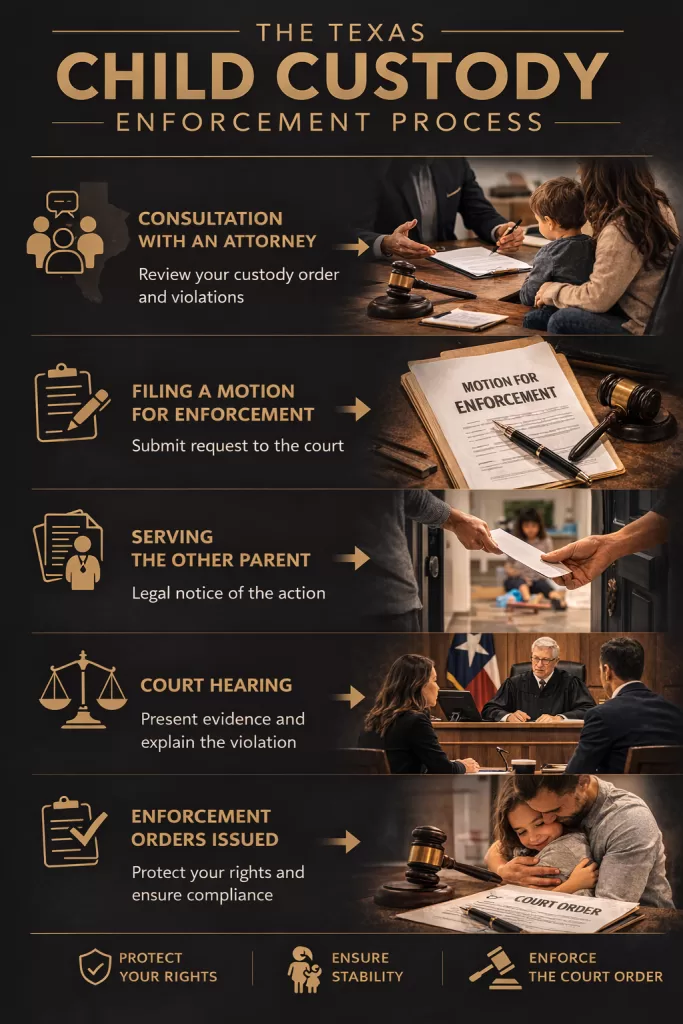
1. Consultation With a Family Law Attorney
The process often begins with a consultation to review the custody order and determine whether a violation has occurred.
During this discussion, the attorney may review:
The existing custody order
Documentation of violations
Possible legal remedies
Options for resolving the issue
This evaluation helps determine whether filing an enforcement action is appropriate.
2. Filing a Motion for Enforcement
If a violation has occurred, a Motion for Enforcement may be filed with the court that issued the original custody order.
This motion asks the court to review the violation and enforce the existing order.
The motion must identify:
The specific order that was violated
The actions that violated the order
The dates and details of the violations
Proper documentation is important when filing an enforcement request.
3. Serving the Other Parent
After the motion is filed, the other parent must be formally notified of the enforcement action.
This process is known as service of process and ensures that the parent has an opportunity to respond to the allegations.
4. Court Hearing
The court will schedule a hearing where both parents may present evidence and testimony.
The judge will review:
The custody order
Evidence of the alleged violations
Statements from both parties
Based on the evidence presented, the court will determine whether the order was violated.
5. Court Enforcement Orders
If the court determines that a parent violated the custody order, the judge may issue enforcement orders to correct the situation.
Possible court actions may include:
Ordering a makeup visitation time
Requiring compliance with the custody schedule
Imposing fines or penalties
Awarding attorney’s fees
In serious cases, holding a parent in contempt of court
The court’s goal is to ensure that the custody order is followed and that the child’s best interests are protected.
How Long Does Custody Enforcement Take?
The timeline for a custody enforcement case can vary depending on several factors.
These may include:
The court’s schedule
The complexity of the case
The number of violations involved
Whether both parents present conflicting evidence
Some enforcement matters may be resolved relatively quickly, while others may require additional hearings.
Why Legal Guidance Is Important in Custody Enforcement Cases
Child custody enforcement cases often require careful documentation and legal filings.
An attorney can assist by:
Reviewing the existing custody order
Gathering evidence of violations
Preparing and filing enforcement motions
Representing you during court hearings
Protecting your parental rights
Legal guidance can help ensure that enforcement actions are properly filed and that the court receives the necessary information to evaluate the case.
Serving Clients Throughout San Antonio and Bexar County
Denis Law Group represents parents in child custody enforcement matters throughout San Antonio and Bexar County family courts.
Our firm serves clients across communities, including:
San Antonio
Alamo Heights
Stone Oak
Helotes
Converse
Live Oak
Universal City
Schertz
If a custody order has been violated, taking legal action may help restore compliance and protect your parental rights.
Schedule a Consultation With a San Antonio Child Custody Enforcement Attorney
When a custody order is not being followed, the situation can quickly become stressful and disruptive for both parents and children.
Legal enforcement actions may help ensure that court orders are respected and that the child’s stability is maintained.
Denis Law Group assists parents throughout San Antonio with custody enforcement matters and other family law disputes.
If you need assistance enforcing a custody order, contact our office to schedule a consultation with a San Antonio child custody enforcement attorney.