
San Antonio Legal Name Change Attorney
Table of Contents
Changing your legal name can mark an important transition in your life. Whether you are changing your name after a divorce, aligning your legal name with your identity, or correcting official records, the process in Texas requires formal court approval and legal documentation.
A legal name change involves filing a petition with the court, completing required background checks, and obtaining a signed order from a judge. While the process may seem straightforward, errors in paperwork or filing requirements can delay approval.
Working with a San Antonio name change attorney can help ensure that the process is completed correctly and efficiently.
At Denis Law Group, we assist individuals throughout San Antonio and Bexar County with legal name change petitions and court filings under Texas law.
Legal Name Change Services in Texas
Texas law allows adults to change their legal name through a court process. Once approved by a judge, the new name becomes the person’s official legal name.
People pursue legal name changes for many reasons, including:
Changing a name after divorce
Correcting a name on legal documents
Personal preference or identity changes
Simplifying a name for professional or personal use
Cultural or religious reasons
Regardless of the reason, the court must review the request and confirm that the name change is not being sought for fraudulent purposes or to avoid legal obligations.
A court order approving the name change allows individuals to update their identification and legal records.
Who Can Request a Legal Name Change in Texas?
Texas law allows most adults to request a legal name change through the court system.
To request a name change in Texas, a person generally must:
Be at least 18 years old
File a petition in the appropriate Texas court
Provide identifying information and background details
Complete required background checks in certain situations
The court will review the request and determine whether the name change is in the public interest and not intended to mislead or defraud others.
If approved, the judge signs an Order Granting Name Change, which becomes the legal document authorizing the new name.
The Legal Name Change Process in Texas
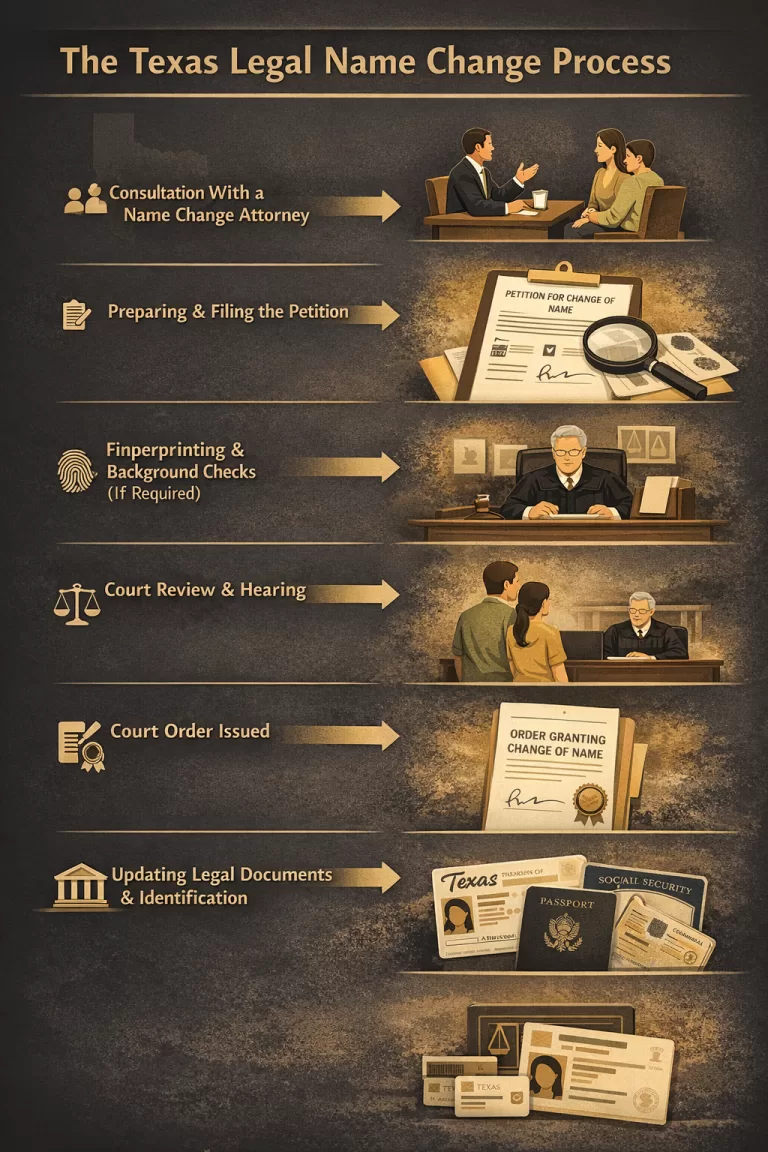
1. Consultation With a Name Change Attorney
The process often begins with a consultation where an attorney reviews your situation and explains the requirements for a legal name change.
During this meeting, you may discuss:
Your reason for changing your name
Required documentation
Court procedures
Expected timeline for approval
Legal guidance can help ensure that all necessary information is included before filing the petition.
2. Preparing and Filing the Petition
To begin the legal process, a Petition for Change of Name of an Adult must be filed with the appropriate Texas court.
The petition typically includes:
Your current legal name
The name you wish to adopt
Your place of residence
Reasons for requesting the name change
Information related to criminal history (if applicable)
Once filed, the court will review the petition and determine whether additional documentation is required.
3. Background Checks and Fingerprinting (If Required)
In some situations, Texas law requires fingerprinting and background checks as part of the name change process.
These checks help ensure that the request is not being made to avoid legal responsibilities, criminal penalties, or debts.
The court may request verification through:
Fingerprint cards
Criminal background checks
Disclosure of prior offenses
Not every case requires fingerprinting, but when it does, these documents must be submitted before the name change can be approved.
4. Court Review and Hearing
Once the petition and supporting documents are filed, the court will review the request.
Some name change cases may require a short court hearing where the judge asks questions about the request.
The court will typically confirm:
The reason for the name change
That the request is not intended to defraud anyone
That the requested name is appropriate under Texas law
If the court is satisfied with the request, the judge will approve the petition.
5. Receiving the Court Order
When the name change is approved, the judge signs an Order Granting Change of Name.
This document officially establishes your new legal name.
Certified copies of the order can then be used to update important records and identification.
6. Updating Legal Documents and Identification
After receiving the court order, individuals must update their name with various government agencies and institutions.
Common updates include:
Social Security records
Texas driver’s license or state ID
Passport
Bank accounts
Employment records
Insurance policies
Updating these records ensures that your new legal name is recognized across official documents.
Common Reasons for Legal Name Changes
People pursue legal name changes for many personal and professional reasons.
Some of the most common situations include:
Name Change After Divorce
After a divorce, many individuals choose to return to a previous surname.
In some cases, the divorce decree restores the former name automatically. In other situations, a separate name change petition may be required.
Correcting Errors on Legal Documents
Errors in legal documents can create complications when applying for identification, employment, or financial services.
A court-ordered name change may help correct discrepancies and ensure records are consistent.
Personal Identity Changes
Individuals may seek a legal name change to better reflect their personal identity or preferred name.
Texas law allows name changes as long as the request is legitimate and not intended to mislead or avoid legal obligations.
Professional or Personal Preference
Some people pursue a name change for practical reasons such as simplifying spelling, improving pronunciation, or aligning their name with personal branding.
How Long Does a Legal Name Change Take in Texas?
The timeline for a name change can vary depending on the court and the details of the case.
In many situations, the process may take several weeks after the petition is filed.
Factors that can affect the timeline include:
Court scheduling
Whether background checks are required
Whether a hearing is necessary
Completeness of the documentation
Working with an attorney can help ensure that filings are completed correctly, which may help avoid delays.
Serving Clients Throughout San Antonio and Bexar County
Denis Law Group assists individuals seeking legal name changes throughout the San Antonio area and Bexar County courts.
Our firm serves clients in communities including:
San Antonio
Alamo Heights
Stone Oak
Helotes
Converse
Live Oak
Universal City
Schertz
If you are considering a legal name change, understanding the court process is an important first step.
Schedule a Consultation With a San Antonio Name Change Attorney
Changing your legal name requires filing a petition with the court and obtaining judicial approval.
Although the process may appear straightforward, ensuring that all paperwork is completed correctly can help avoid delays or complications.
Denis Law Group assists individuals throughout San Antonio with legal name change petitions and court procedures.
If you would like guidance through the process, contact our office to schedule a consultation with a San Antonio name change attorney.
Guidance You Can Trust
stay informed
Subscribe to our newsletter for clear, compassionate insights on family law, mediation, and life changes that matter to you.
By subscribing, you have read and understood our privacy policy and agree to our terms and conditions
Guidance You Can Trust
stay informed
Subscribe to our newsletter for clear, compassionate insights on family law, mediation, and life changes that matter to you.
By subscribing, you have read and understood our privacy policy and agree to our terms and conditions
Frequently Asked Questions About Legal Name Changes in Texas
How do you legally change your name in Texas?
To legally change your name in Texas, you must file a Petition for Change of Name of an Adult with the appropriate court.
The court will review the petition and determine whether the name change should be approved. If granted, the judge signs an order legally establishing the new name.
Do you need a lawyer to change your name in Texas?
Texas law does not require an attorney to request a name change, but legal guidance can help ensure that the paperwork and court requirements are handled properly.
An attorney can assist with preparing the petition, filing the documents, and addressing any issues that arise during the process.
How much does a legal name change cost in Texas?
The cost of a name change can vary depending on court filing fees, fingerprinting requirements, and other administrative costs.
Some individuals also choose to work with an attorney to assist with preparing and filing the required paperwork.
Can you change your name for any reason?
Texas courts generally allow name changes as long as the request is not intended to commit fraud, avoid debts, or evade criminal penalties.
The judge will review the circumstances of the request before approving the name change.