
San Antonio Adoption Attorney
Table of Contents
Adoption is one of the most meaningful ways to build or expand a family. Whether you are a stepparent who has helped raise a child for years, a grandparent seeking legal stability for a grandchild, or a family welcoming a child through foster care or private adoption, the legal process in Texas requires careful planning and proper court filings.
Adoption establishes a permanent legal parent-child relationship. Once finalized by a Texas court, adoptive parents receive the same legal rights and responsibilities as biological parents. This includes the authority to make decisions regarding the child’s education, healthcare, and overall well-being.
However, adoption is also a detailed legal process that must comply with Texas family law requirements. Courts must review the circumstances of the adoption, confirm that parental rights have been properly addressed, and determine that the adoption is in the child’s best interests.
Working with a San Antonio adoption attorney can help families navigate this process with confidence. Legal guidance ensures that paperwork is properly filed, legal requirements are met, and the adoption moves forward as smoothly as possible.
At Denis Law Group, we assist families throughout San Antonio with a wide range of adoption matters, including stepparent adoptions, relative adoptions, foster care adoptions, and private adoptions.
Schedule a consultation today to discuss your adoption case and learn how we can help guide your family through the legal process.
Adoption Legal Services in San Antonio
Adoption cases can arise in many different circumstances. Each situation involves specific legal requirements and documentation that must be presented to the court.
Our firm helps families with a variety of adoption matters, including the following.
Private Adoption
Private adoptions occur when adoptive parents work directly with birth parents or through a licensed adoption agency.
These adoptions typically involve:
Adoption agencies or attorneys facilitating placement
Consent from the birth parents
Legal documentation outlining the adoption agreement
Court approval to finalize the adoption
Private adoption cases can involve unique legal considerations, including ensuring that consent is properly obtained and that the adoption complies with Texas law.
Legal guidance can help families understand their rights and responsibilities throughout the process.
Foster Care Adoption
Many children in Texas foster care are eligible for adoption when reunification with their biological parents is no longer possible.
Foster care adoption often begins when a child is placed with a foster family. Over time, if the child cannot safely return to their biological parents, the foster parents may have the opportunity to pursue adoption.
This process usually involves working with the Texas Department of Family and Protective Services and completing the legal steps required for adoption finalization.
For families who have already formed strong bonds with a foster child, adoption can provide permanent stability and legal security.
Stepparent Adoption
Stepparent adoption is one of the most common types of adoption cases in Texas. In these situations, a stepparent seeks to become the child’s legal parent.
Many stepparents have played an important role in a child’s life for years. Adoption allows the law to recognize that relationship permanently.
A stepparent adoption typically involves several legal steps, including:
Filing a petition for adoption with the court
Obtaining consent from the other biological parent or terminating their parental rights
Completing required background checks
Attending a court hearing for finalization
Once the adoption is finalized, the stepparent becomes the child’s legal parent with the same rights and responsibilities as a biological parent.
This can provide stability for the child and ensure the family’s legal relationships are clearly established.
Relative or Kinship Adoption
Relative adoption allows a family member to adopt a child when the biological parents are unable to provide proper care.
These situations may involve:
Grandparents raising grandchildren
Aunts or uncles caring for a child
Other relatives who have taken on a parental role
Adoption can provide long-term legal security for the child by establishing a permanent parental relationship.
Relative adoptions often arise after extended periods where the child has already been living with the adopting family member. Formalizing the relationship through adoption can ensure the child has a stable legal home and that the adoptive parent can make important decisions on the child’s behalf.
Understanding the Adoption Process in Texas
Adoption laws are designed to ensure that every adoption protects the best interests of the child while respecting the legal rights of all parties involved.
Although each adoption case is unique, most adoptions in Texas follow several key steps.
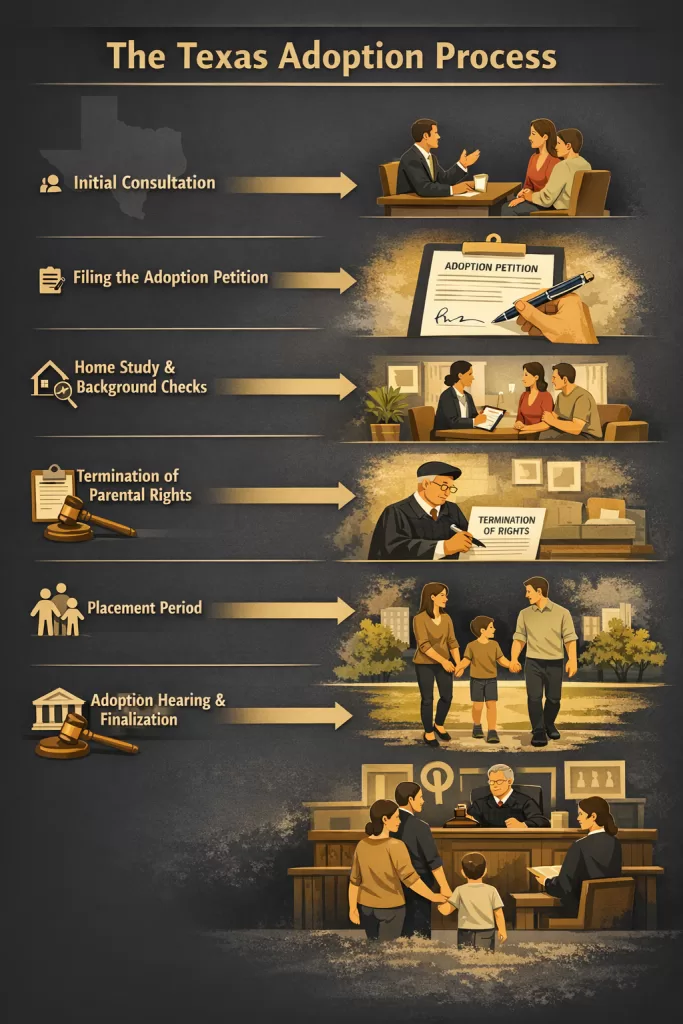
Step 1: Meeting Basic Adoption Requirements
Texas law requires adoptive parents to meet certain eligibility standards before an adoption can proceed.
Generally, prospective adoptive parents must:
Be at least 21 years old
Demonstrate financial stability
Complete an adoption application
Provide references
Submit to criminal background checks
These requirements help ensure that adoptive families are prepared to provide a safe and stable home for the child.
Step 2: Home Study and Background Checks
Most adoption cases require a home study, which is an evaluation conducted by a licensed professional.
The home study process typically includes:
Interviews with family members
Review of financial and employment history
A home inspection
Criminal background checks
Child abuse registry checks
The goal of the home study is not to judge a family’s lifestyle but to ensure that the home environment is appropriate and supportive for the child.
Step 3: Termination of Parental Rights
Before an adoption can be finalized, the parental rights of the biological parents must be addressed.
This can occur in one of two ways:
Voluntary relinquishment – The biological parent consents to the adoption.
Court-ordered termination – The court terminates parental rights when certain legal grounds exist.
Termination of parental rights is a serious legal matter. Courts carefully review these cases to ensure that the decision is in the child’s best interests.
Step 4: Child Placement
Once the necessary legal requirements are met, the child is placed with the adoptive family.
Texas law often requires the child to live with the adoptive parent for a period of time before the adoption can be finalized. This period allows the court to ensure the placement is stable and appropriate.
During this time, families may continue working with social workers or agencies involved in the adoption process.
Step 5: Adoption Finalization Hearing
The final step in the adoption process is a court hearing.
During this hearing, the judge will review the adoption petition, supporting documents, and the circumstances of the adoption.
If the court determines that the adoption serves the child’s best interests, the judge will sign an Order of Adoption.
Once this order is issued:
The adoptive parents become the child’s legal parents
A new birth certificate may be issued
The adoption becomes permanent under Texas law
For many families, this hearing is an emotional and meaningful moment as the adoption becomes official.
Common Adoption Situations We Help Families Navigate
Every family’s adoption journey is unique. Some families pursue adoption after years of raising a child, while others begin the process through agencies or foster care.
Our firm helps clients address a variety of adoption situations, including:
Stepparents seeking legal parental rights
Grandparents adopting grandchildren
Family members adopting relatives
Foster parents adopting children in their care
Private adoptions through agencies or direct placement
Cases involving termination of parental rights
Regardless of the circumstances, legal guidance can help ensure the process is completed properly and efficiently.
Serving Families Throughout San Antonio
Denis Law Group assists families with adoption matters throughout the San Antonio area and surrounding communities.
Our firm represents clients in family courts across Bexar County and the surrounding area, helping parents complete the legal process required to finalize an adoption in Texas.
We assist clients throughout:
San Antonio
Alamo Heights
Stone Oak
Helotes
Converse
Live Oak
Universal City
Schertz
If you are considering adoption in the San Antonio area, our firm can help you understand the legal steps involved and guide you through the process.
Why Legal Guidance Is Important in Adoption Cases
Adoption involves more than completing paperwork. The process requires compliance with Texas family law, court procedures, and strict documentation requirements.
Even small mistakes in filings or documentation can cause delays.
Working with an experienced adoption attorney can help ensure that:
Legal documents are properly prepared and filed
Court requirements are met
Parental rights issues are addressed correctly
The adoption process proceeds without unnecessary delays
Legal guidance can also help families understand their options and navigate unexpected issues that may arise during the adoption process.
How an Adoption Attorney Can Help Your Family
Adoption is both a legal process and a personal journey. Families often have questions about the requirements, timelines, and legal steps involved.
An adoption lawyer can assist by:
Explaining the adoption process in Texas
Preparing and filing adoption petitions
Addressing parental rights and consent issues
Coordinating with agencies or social workers
Representing families during court hearings
Ensuring the adoption is legally finalized
Having an attorney guide the process allows families to focus on preparing for the future while ensuring the legal requirements are handled properly.
Experienced Guidance for Texas Adoption Cases
Adoption cases require careful legal preparation and attention to Texas family law requirements.
Denis Law Group represents families throughout San Antonio in a variety of family law matters, including adoption and parental rights cases. Our firm is committed to helping families complete the legal process efficiently while protecting the best interests of the child.
Related Family Law Services
Child support cases often involve other family law matters. Denis Law Group also assists clients with:
Guidance You Can Trust
stay informed
Subscribe to our newsletter for clear, compassionate insights on family law, mediation, and life changes that matter to you.
By subscribing, you have read and understood our privacy policy and agree to our terms and conditions
Frequently Asked Questions About Adoption in Texas
How long does the adoption process take in Texas?
The timeline for adoption depends on the type of adoption and the circumstances of the case. Some adoptions, such as stepparent or relative adoptions, may take several months to complete. Other cases, particularly those involving agencies or foster care, may take longer.
Texas law often requires the child to live with the adoptive parent for at least six months before the adoption can be finalized, although courts may waive this requirement in certain situations.
Do both biological parents have to consent to adoption?
In most cases, the biological parents must either consent to the adoption or have their parental rights legally terminated by a court.
If a parent cannot be located, refuses consent, or has abandoned the child, the court may determine whether termination of parental rights is appropriate under Texas law.
How much does adoption cost in Texas?
The cost of adoption varies depending on the type of adoption. Stepparent or relative adoptions are often less expensive because they typically involve fewer agency fees.
Private adoptions or agency adoptions may involve additional costs such as home studies, agency services, and court expenses.
We can explain the potential costs involved based on your situation.
Can grandparents adopt their grandchildren in Texas?
Yes. Texas law allows grandparents and other relatives to adopt a child when the biological parents are unable to provide care.
In these cases, the court must review the circumstances and determine that the adoption is in the child’s best interests.
Do you need a lawyer for adoption in Texas?
Texas law does not always require an attorney for adoption, but legal representation can help ensure that the process is completed correctly.
Adoption cases often involve complex legal requirements, including termination of parental rights, court filings, and compliance with state laws. An adoption attorney can help families navigate these issues and avoid unnecessary delays.
